Inspiration
The ʻiʻiwi (Drepanis coccinea) was first documented scientifically by naturalists during Captain James Cook’s third Pacific voyage, which took place from 1776 to 1780. The ʻiʻiwi was historically abundant across the Hawaiian Islands and could easily be spotted in native forests and in areas of flowering plants where they foraged for nectar. However, over the past century its population has experienced significant declines and is now extinct on the islands of Lana’i and Oahu.
Conservation Status
Federally Listed
Threatened
🔶
State Listed
Endangered
🔶
State Recognized
Endemic
💛
Species Summary
The ʻiʻiwi (Drepanis coccinea, previously classified as Vestiaria coccinea) is a colorful bird endemic to Hawai’i that primarily feeds on nectar from native flowers. While once abundant across the Hawaiian Islands, the ʻiʻiwi’s population has drastically declined due to habitat loss, invasive species, and diseases. Today, it is mainly found in high-elevation wet forests. Today, the ‘i’iwi is only found on Hawai’i Island, Maui, and Kauai, where their populations continue to decline. Conservation efforts are critical to protect this iconic species from further decline.
Species Description
The ʻiʻiwi is a species of Hawaiian honeycreeper characterized by its brilliant crimson plumage, black wings and tail, and a long, curved bill adapted for nectar feeding. The ʻiʻiwi’s specialized bill facilitates pollination, making it an essential part of the ecosystem.

Adult male and female: Scarlet plumes, black wings and tail, and a small white patch on the inner secondary feathers. Yellow eyering. Salmon-colored, long and curved bill. Male slightly larger than female. Length: 5.5″ (14 cm) Weight: .5-.7 oz (15-20 g)
Photo credit: Kahn, N. (2012). Adult iiwi.
Juvenile: plumes are optimized for camouflage, mottled orange, yellow, and brown . Tan eyering, black wings and tail feathers. Small white patch on inner secondaries present.
Photo credit: Raspet, C/iNaturalist (2023)

Threats

Habitat Loss: Deforestation reduce the availability of native forests, which are crucial for the ‘i’iwi’s survival.
Avian Diseases: Avian malaria has a devastating impact on ‘i’iwi populations, as the birds have little natural resistance to the disease. Climate change exacerbates this threat by enabling mosquitoes to invade higher elevation forests, which were previously safe habitats for the ‘i’iwi.
Predation and Invasive Species: Hooved animals like feral goats and pigs can damage healthy trees by digging up roots and stripping bark, which can increase the risk of the tree catching Rapid ʻŌhiʻa Death (ROD), a fungal disease.
Photo credit: Smith, I. (2023). Ohia Lehua at Volcanoes National Park
Conservation
Conservation initiatives encompass multiple dimensions, and according to the US Fish and Wildlife Service, the most important conservation efforts for the ‘i’iwi include the designation of critical habitats and the management of mosquito-borne diseases. One key strategy is the use of mosquito birth control, which involves releasing sterile male mosquitoes to reduce the overall mosquito population. Additionally, habitat management is crucial, as protecting and restoring high-elevation forests where mosquitoes are less prevalent helps create safer environments for the ‘i’iwi.
You can help by cleaning your shoes after visiting island forests, to help prevent the spread of ROD.
Nature Art
What a fun species to draw and paint! I composed two adults and a juvenile ‘i’iwi on māmane tree branch. I’ve also included illustrations by Frohawk (1890). He must have been intrigued by this bird, since there are two illustrations of this species found in his published work.

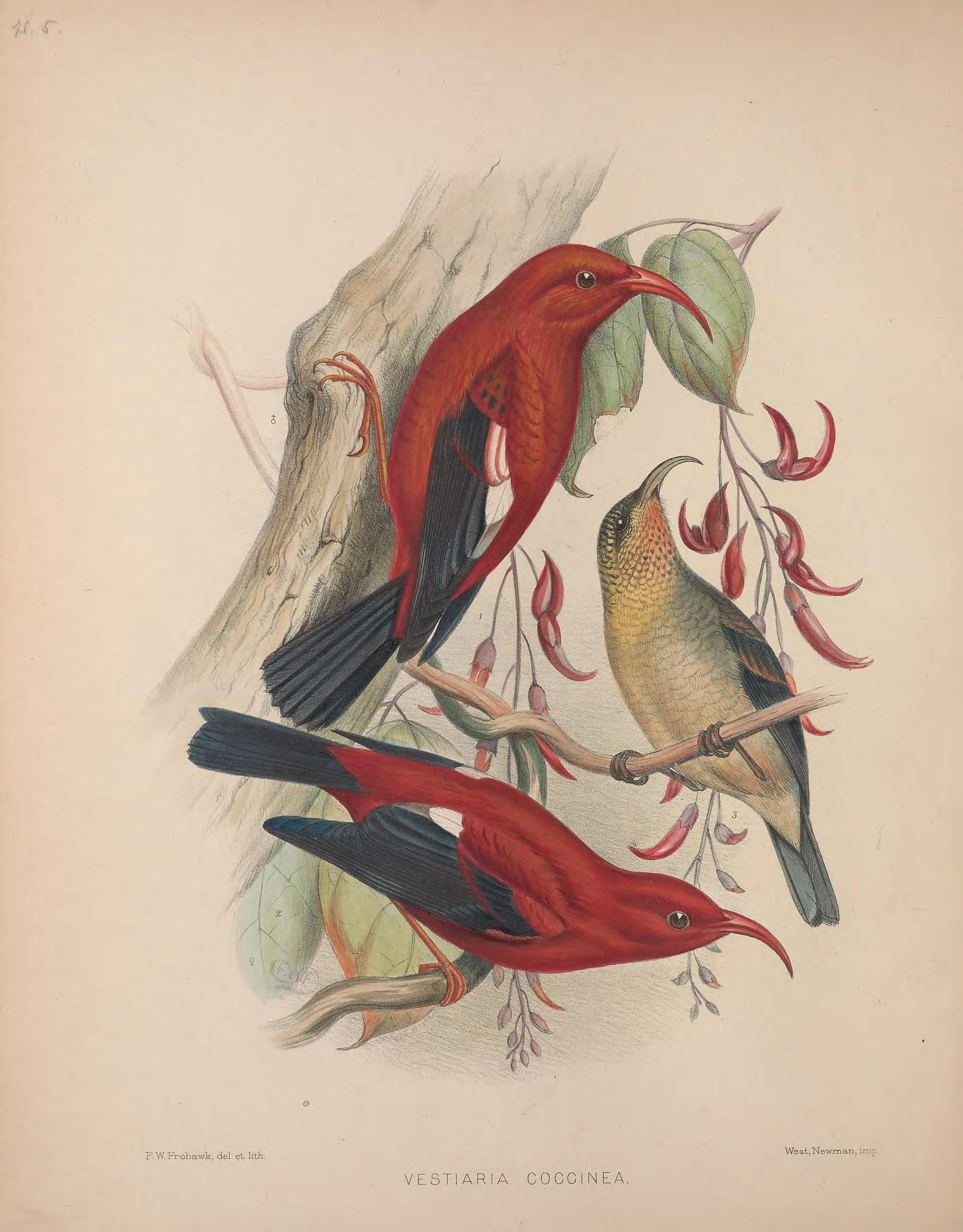

Illustration credits (left to right): Smith I. (2024). I’iwi perched on mamane; Frohawk (1890). Vestiaria n57_w1150; Frohawk (1890) Vestiaria n59_w1150

While the ‘i’iwi’s primary food source is the ʻōhiʻa lehua, they also feed on nectar from the mamane blossom. The mamane tree is the most prevalent tree on the higher elevations of Mauna Kea.
This photo shows the beautiful māmane blossom. If you’re a gardener, the blossom will be familiar to you, as the tree is related to the pea and bean family. The māmane is endemic to Hawai’i.
Photo credit: Starr (2005). Sophora chrysophylla (māmane).
References
Click here to see the references >>>
American Bird Conservancy. (n.d.). ‘I’iwi. Retrieved July 11, 2024, from https://abcbirds.org/bird/Iiwi/
Audubon. (2017, October 4). The ‘I’iwi, a besieged Hawaiian forest bird, now listed as threatened. Audubon. Retrieved July 15, from https://www.audubon.org/news/the-iiwi-besieged-hawaiian-forest-bird-now-listed-threatened
Fitzgerald, S. (2018, June 13). Keeping hope alive for Hawaii’s ‘i’iwi. All About Birds. Retrieved July 11, 2024, from https://www.allaboutbirds.org/news/keeping-hope-alive-for-hawaiis-iiwi/
Frohawk, F.W., del. et. lith (1890-1899). Vestiaria n57_w1150 [image of illustration]. In Aves Hawaiienses : the birds of the Sandwich Islands. Public domain. Retrieved March 3, 2024, from https://www.flickr.com/
Frohawk, F.W., del. et. lith (1890-1899). Vestiaria n59_w1150 [image of illustration]. In Aves Hawaiienses : the birds of the Sandwich Islands. Public domain. Retrieved March 3, 2024, from Retrieved March 3, 2024, from https://www.flickr.com/
Hawaii Audubon Society. (2005). Hawaii’s birds (6th ed.).
Hawaii Department of Land and Natural Resources. (n.d.). ‘I’iwi. Retrieved July 11, 2024, from https://dlnr.hawaii.gov/wildlife/birds/iiwi/
Hawaii Department of Land and Natural Resources. (2015). ‘I’iwi (Vestiaria coccinea) conservation status and management (Hawaii State Wildlife Action Plan). Retrieved July 11, 2024, from https://dlnr.hawaii.gov/wildlife/files/2019/03/SWAP-2015-Iiwi-Final.pdf
Kahn, N., USFWS. (2012). Adult iiwi [photograph]. Public Domain. BY CC2.0. Retrieved June 13, 2024, from https://commons.wikimedia.org/wiki/File:Adult_iiwi_(7123152639).jpg
McGlashen, A. (2017, September 20). The ‘I’iwi, a besieged Hawaiian forest bird, is now listed as threatened. Audubon. Retrieved July 11, 2024, from https://www.audubon.org/news/the-iiwi-besieged-hawaiian-forest-bird-now-listed-threatened
Paxton, E. H., Camp, R. J., Gorresen, P. M., Crampton, L. H., Leonard, D. L., & VanderWerf, E. A. (2013). ‘I’iwi (Vestiaria coccinea) conservation status and management (Pacific Rim Conservation Technical Report). Pacific Rim Conservation. Retrieved July 11, 2024, from https://pacificrimconservation.org/wp-content/uploads/2013/10/Iiwi.pdf
Raspet, C./iNaturalist (2023). ʻIʻiwi (Drepanis coccinea) [photograph, cropped from original]. CC BY 4.0 , Retrieved July 11, 2024 from https://commons.wikimedia.org
Smith, I. (2024). Hawaii male and female akepa perched on ohia lehua branch. [Photograph of painting]. Medium Arches 140lb cold pressed 100% cotton paper
Starr, F. & K. (2005). Sophora chrysophylla [photograph]. CC BY 3.0. Retrieved July 10, 2024, from https://commons.wikimedia.org/
U.S. Fish and Wildlife Service. (2022, December 28). U.S. Fish and Wildlife Service proposes critical habitat for ‘i’iwi [Press release]. U.S. Department of the Interior. Retrieved July 11, 2024, from https://www.fws.gov/press-release/2022-12/us-fish-and-wildlife-service-proposes-critical-habitat-iiwi
U.S. Forest Service. (n.d.). ‘I’iwi conservation efforts. U.S. Department of Agriculture. Retrieved July 11, 2024, from https://www.fs.usda.gov
U.S. Fish and Wildlife Service. (n.d.). ‘I’iwi critical habitat. U.S. Department of the Interior. Retrieved July 11, 2024, from https://www.fws.gov/project/iiwi-critical-habitat
U.S. Fish and Wildlife Service. (n.d.). ‘I’iwi (Vestiaria coccinea). U.S. Department of the Interior. Retrieved July 11, 2024, from https://ecos.fws.gov/ecp/species/9076
#hawaii #watercolor #endangeredbirds 💛💜💚
 Inga J Smith
.jpg)