The ʻalawī (Loxops mana), also known as the Hawaiʻi creeper, is a small, unassuming Hawaiian honeycreeper found only on the island of Hawai‘i. Endemic to high‑elevation forests on the Big Island, this little bird plays an important ecological role while facing severe threats to its survival.
Conservation status
Like many native Hawaiian forest birds, the ʻalawī is listed as endangered both federally and by the State of Hawai‘i.
Federal
Endangered
🔶
State
Endangered
🔶
State
Endemic
💛
Although estimated at roughly 12,000 individuals, the ʻalawī remains endangered, facing threats from disease, invasive predators, and habitat loss. Compared with other Hawaiian honeycreepers that number only in the hundreds, this relatively higher count reflects its somewhat broader range on the Big Island — but does not lessen its vulnerability.”
Species Description
The ʻalawī is a small bird — about 4.5 inches (11 cm) long — with olive‑green upperparts and a buff‑colored underside, blending seamlessly into its forest home. Adults have a distinctive dark gray mask around the eyes, and a short, sharp bill adapted for probing bark and branches as it gleans insects and spiders under the surface of trees.
Despite its modest appearance, the ʻalawī has a fascinating natural history: it was long mistaken for other small forest birds until ornithologists confirmed its unique identity. Its traditional Hawaiian name, ʻalawī, was rediscovered and reinstated in recent years, reconnecting this species to cultural knowledge and language.
Habitat and Ecology
Unlike migratory songbirds elsewhere, the ʻalawī is nonmigratory and stays within montane and mesic‑wet forests, especially those dominated by native ōhi‘a and koa trees at elevations between about 1,000–7,500 ft (300–2,300 m). It climbs tree trunks and branches — much like a miniature treecreeper — searching for insects beneath bark, moss, and lichen.
Threats and Conservation
The ʻalawī faces many of the familiar challenges that have devastated Hawaii’s native forest birds:
- Habitat degradation: Forest fragmentation and loss due to logging and ungulate damage reduce suitable territory.
- Invasive predators: Rats, cats, and other non‑native mammals prey on eggs and chicks.
- Disease: Avian malaria and pox, spread by introduced mosquitoes, limit the ʻalawī’s range to higher, cooler elevations where mosquitoes are less common.
- Climate change: Warming temperatures enable disease vectors to move upslope, shrinking the bird’s disease‑free habitat.
Ongoing conservation work focuses on habitat protection, predator control, and disease management to help stabilize and recover ʻalawī populations on the Big Island
Nature Art
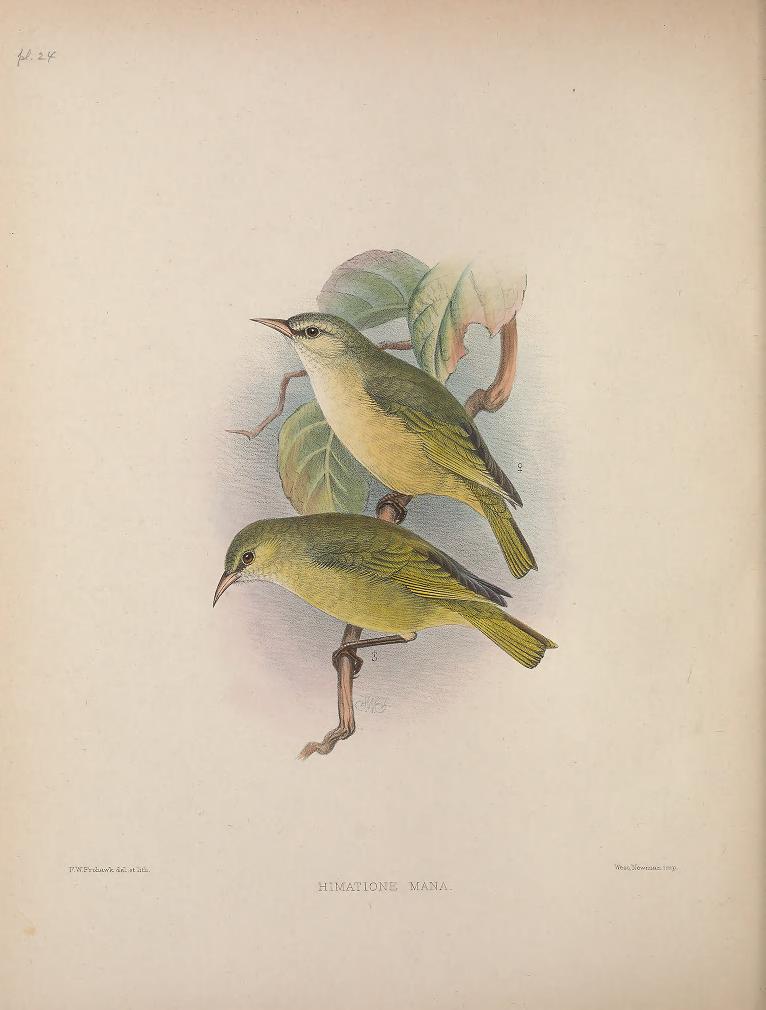
The historic illustration by Frederick William Frohawk shows the ʻalawī (Himatione mana) perched quietly, highlighting its olive‑green back and pale underside. The delicate details capture the charm of this tiny Big Island honeycreeper.
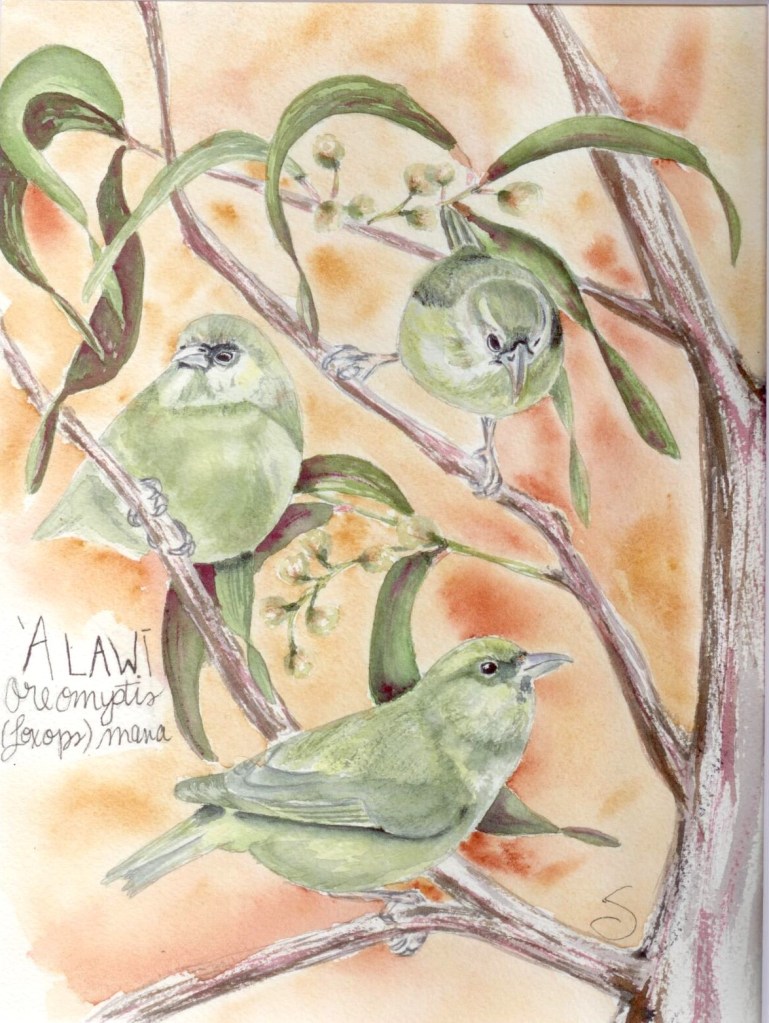
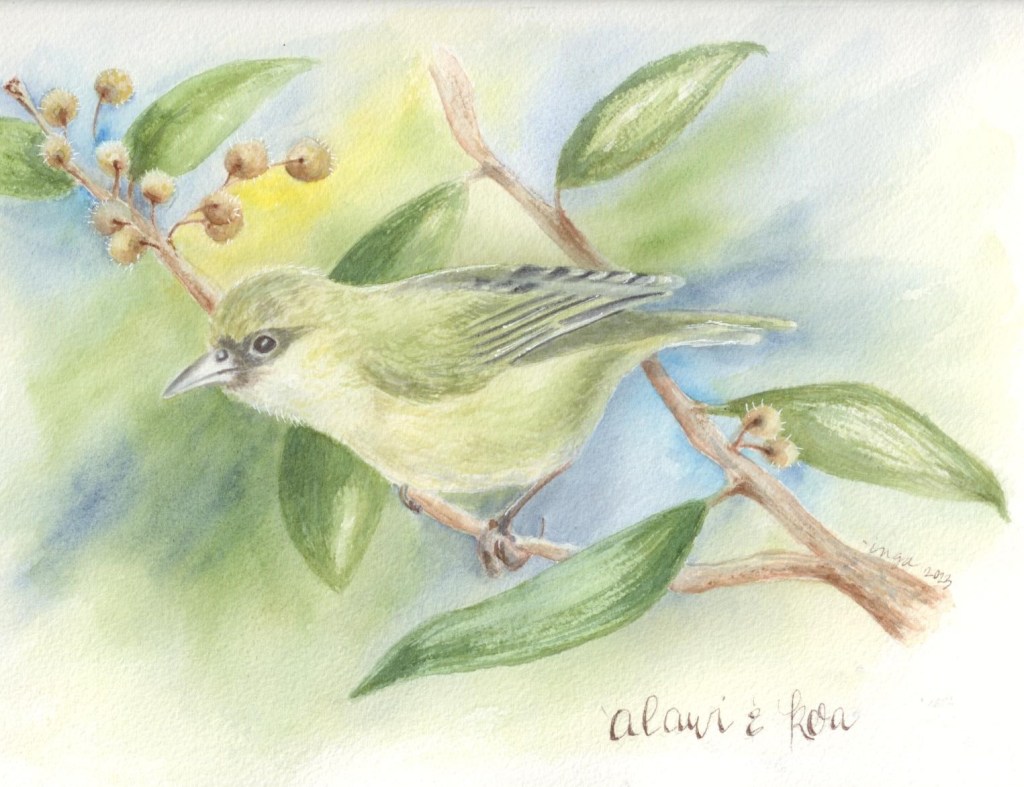
I’ve tried to capture this sweet bird in natural environment. In the first painting, three ʻalawī — male, female, and juvenile — perched among the blossoms of a koa tree, each rendered in varying shades of green to capture their subtle differences. My second painting depicts a single ʻalawī perched in a koa, highlighting the bird’s delicate form and quiet presence within its natural habitat.
Cover Photo credit: Hawaiʻi creeper (Loxops mana) photographed in Hakalau Forest National Wildlife Refuge TonyCastro (2014)
References
ABC Birds. (n.d.). ʻAlawī / Hawai‘i creeper (Loxops mana). American Bird Conservancy. Retrieved February 1, 2026, from https://abcbirds.org/bird/alawi/?utm_source=chatgpt.com
Castro, T. (2014, February 22). Hawaiʻi creeper (Loxops mana) [Photograph]. Wikimedia Commons. CC BY‑SA 4.0. Retrieved February 1, 2026, from https://upload.wikimedia.org/wikipedia/commons/1/14/Hawai%E2%80%99i_Creeper.jpg
Frohawk, F. W. (1890–1899). Himatione mana [Illustration]. In Aves Hawaiienses: The birds of the Sandwich Islands (plate 130). Public domain. Wikimedia Commons. Retrieved March 9, 2024, from https://upload.wikimedia.org/wikipedia/commons/1/14/Himatione_mana_AvesHawaiienses00Wils_0130.jpg
Hawai‘i Department of Land and Natural Resources. (n.d.). ʻAlawī (Himatione mana). Retrieved February 1, 2026, from https://dlnr.hawaii.gov/wildlife/birds/alawi/?utm_source=chatgpt.com
Hawai‘i Forest Bird Survey. (2008). Population trends of native Hawaiian forest birds 1976–2008. University of Hawai‘i at Hilo. Retrieved February 1, 2026, from https://hilo.hawaii.edu/hcsu/documents/HCSU012CampetalPopulationtrendsofnativeHawaiianforestbirds1976-2008FINAL.pdf?utm_source=chatgpt.com
Kawaiola, N. (n.d.). Ka ʻŪlila ʻOma‘omao: Rediscovering the ʻalawī. Kawaiola News. Retrieved February 1, 2026, from https://kawaiola.news/columns/na-mana-hoa/ka-uila-omaomao/?utm_source=chatgpt.com
Smith, I (2024). Alawi family; Alawi in koa. [illustrations]. Shared with permission.
Wikimedia Commons. (n.d.). File:Aves Hawaiienses – the birds of the Sandwich Islands (IA AvesHawaiienses00Wils) plate 130.png. Retrieved March 9, 2024, from https://commons.wikimedia.org/wiki/File:Aves_Hawaiienses_-_the_birds_of_the_Sandwich_Islands_(IA_AvesHawaiienses00Wils).pdf?utm_source=chatgpt.com
 Inga J Smith

