Inspiration
When I first moved to Hawaii, I was saddened by an Audubon Society seminar that described the endangered birds of Hawaii Island. That started me on a journey of discovering more about endangered species here at home and around the world. This post begins a series showcasing the five endangered Hawaii Island forest birds.
Conservation Status
Federally Listed
Endangered
🔶
State Listed
Endangered
🔶
State Recognized
Endemic
💛
Species Summary
The Hawai’i ‘Ākepa (Loxops coccineus coccineus) is a small, vibrant honeycreeper endemic to the island of Hawaii. It is known for its unique foraging behavior of prying open leaf buds and bark crevices in search of insects and nectar. The Hawai’i ‘Ākepa relies heavily on the ‘ōhi‘a lehua and koa, both Hawaiian trees, as these provide essential food sources and nesting sites crucial for their survival. The species is reported to be found only above 4300 feet in wet forests on the island of Hawai’i.
Species Description
Unlike the already extinct Maui Ākepa, the Hawai’i ‘Ākepa is a small sexually dichromatic forest bird and is considered endemic to the island of Hawaii. The Hawai’i Ākepa boasts vibrant colors as follows:
Male: upper and under parts bright orange-red; primary, secondary, tertiary feather groups, and alulas brown; tail brown-black; coverts red-brown; head bright orange-red; eye ring yellow; black eyes; bill pale yellow; legs brown-black.
Female: upper parts, and head gray-green; pale yellow eyering; black eyes; breast pale yellow-orange; flank pale green-gray; wings brown; tale brown-black; bill pale yellow; legs brown-black.

Length: 4-5″ (10 cm)
Wingspan: 6.75″ (17.1cm)
Weight: .37 oz oz (10.5g)
Photo credit: Schmierer, A. (2017). Akepa (Loxops coccineus)
Threats
Habitat Loss: Logging and ranching in the 1800s fragmented the slow-growing native forests. In addition, since 2014, 1 million ‘ōhi‘a lehua trees have perished due to a fungal disease called Rapid ‘Ōhi’a Death (ROD).
Disease: Avian malaria, which is spread by non-native mosquitos.
Predation: Rats easily access nests and consume nestlings and eggs. Rats are non-native and have few predators in Hawaii. Mongoose were introduced in 1883 to control rats. Sadly, mongoose are now invasive and also negatively impact native bird populations.
Photo credit: Smith, I. (2023). ‘ōhi‘a lehua in Volcanoes National Park

Conservation
While active conservation efforts are multifaceted, according to the US Fish and Wildlife Service, the most important conservation effort is habitat protection. Since 1989, 1/2 million native trees have been planted. Learn more about Hakalau Forest Restoration.
One thing everyone can do: clean shoes after hiking in the forests to help prevent the spread of ROD fungus. I always bring a change of shoes after hiking here on the Big Island. Afterall, I’d rather be wearing sandals anyway!
Nature Art
I composed the male and female Ākepas on an ōhi‘a lehua branch to reinforce the fragile beauty of both species here on the island. I’ve also included historical paintings for reference and inspiration.
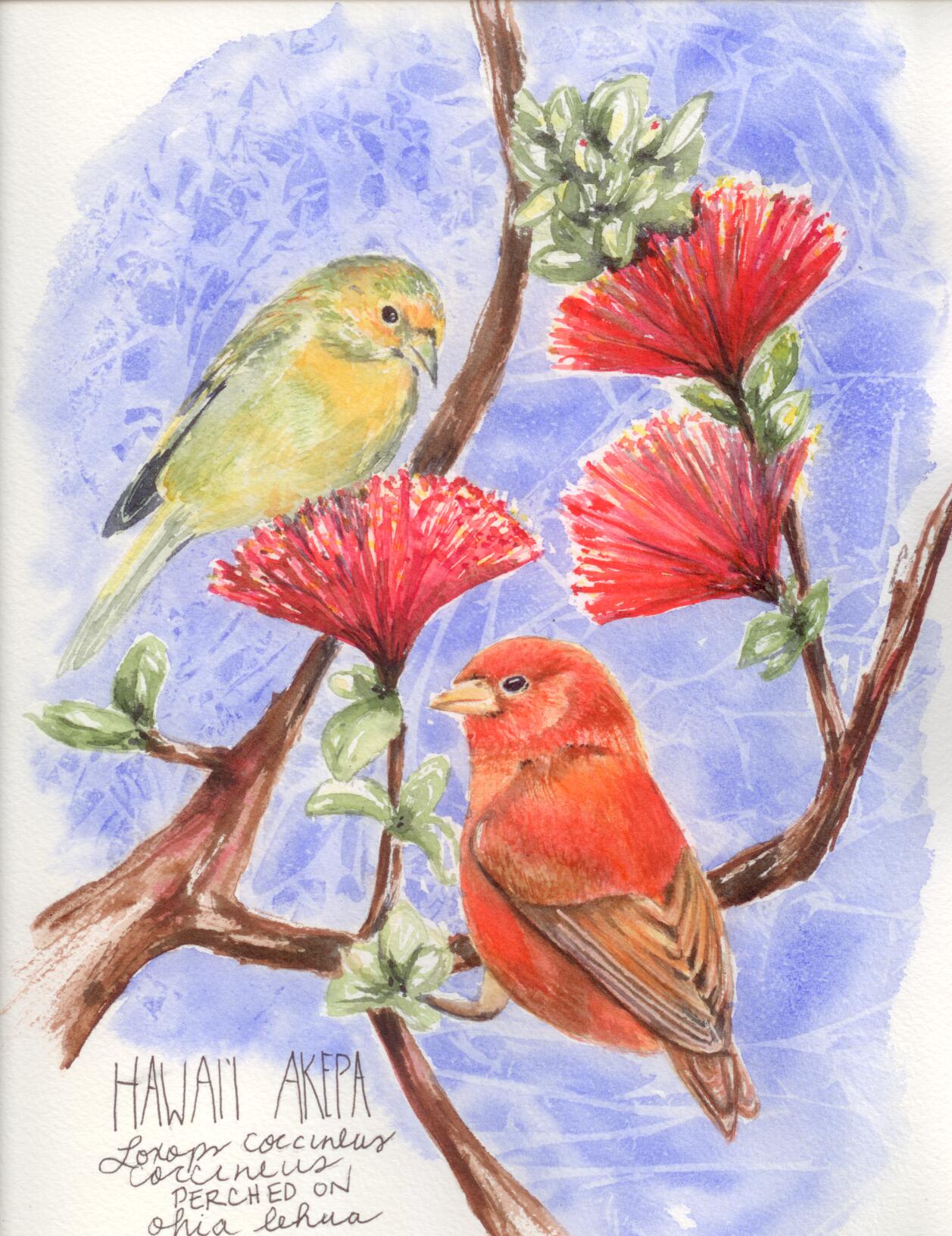
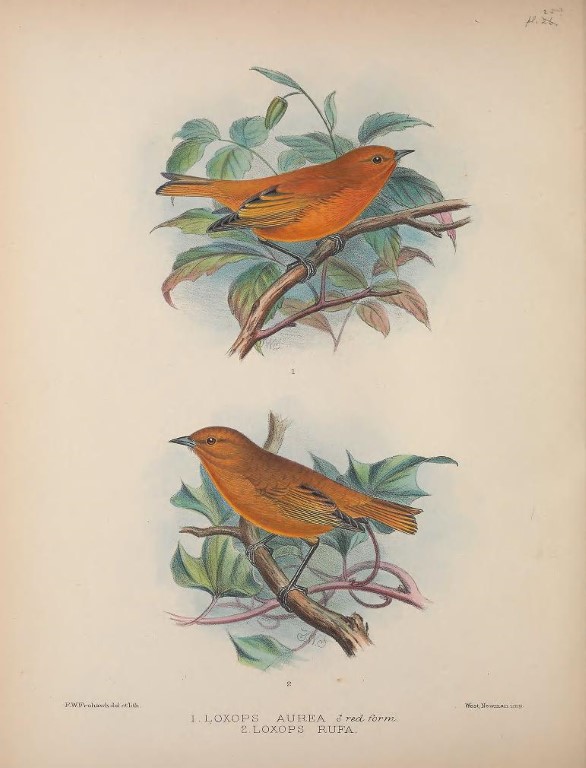

Illustration credits (left to right): Smith I. (2024). Hawaii Akepa perched on ohia lehua; Frohawk (1890). Loxops coccineus rufa; Dranga (n.d.). Ohia Lehua Blossoms
References
Castro, T. (2014). Akepa. [photograph]. CC BY-SA 4.0. Retrieved February 25, 2024, from https://en.m.wikipedia.org/wiki/File:%E2%80%98Akepa.jpg
Dranga, H. (n.d.). Ohia Lehua Blossoms (Metrosideros polymorpha) [image of gouache on paper]. Public domain, via WikiCommons. Retrieved February 26, 2024, from https://commons.wikimedia.org
Endangered Species Spotlight: ‘Ākepa (Loxops coccineus) (n.d). US Fish and Wildlife Service. Retrieved July 8, 2024, from https://www.fws.gov/story/endangered-species-spotlight-akepa-loxops-coccineus
Frohawk, F. (1890). Loxops coccineus rufa [image of book illustration] from The Birds of the Sandwich Islands. Public domain, via Wikimedia Commons. Retrieved February 26, 2024, from https://commons.wikimedia.org
Hawaii Audubon Society. (2005). Hawaii’s birds (6th ed.).
Hawaiʻi ʻĀkepa. Division of Forestry and Wildlife: Wildlife Program (n.d.). Retrieved July 7, 2024, from https://dlnr.hawaii.gov/wildlife/birds/hawaii-akepa/
Mossman, B. (n.d.). Hawai’i ʻĀkepa. [photograph]. Retrieved 2/25/2024, from https://dlnr.hawaii.gov/wildlife/birds/hawaii-akepa/
Schmierer, A. (2017). Akepa (Loxops coccineus) male. [photograph]. BY CC1.0, via Wikimedia Commons. Retrieved February 27, 2024, from https://commons.wikimedia.org
Sherony, D. (2016). Hawaii Akepa (Loxops coccineus). [photograph]. CC BY-SA 2.0 , via Wikimedia Commons. Retrieved July 5, 2024 from https://commons.wikimedia.org/
Smith, I. (2024). Hawaii male and female akepa perched on ohia lehua branch. [Photograph of painting]. Medium Arches 140lb cold pressed 100% cotton paper
#hawaii #watercolor #endangeredbirds 💛💜💚
 Inga J Smith

Amazing
LikeLike